— 1 of 10 —
PAGE 1 — EXT. CITY FARMERS MARKET — MORNING
FADE IN:

A bustling farmers market. Stalls of fresh produce, handmade goods, street food. MATEO (50s, weathered hands, owns a tamale cart) is setting up when COUNCILWOMAN GRANT (40s, clipboard, blazer over jeans) approaches with a CITY INSPECTOR.

COUNCILWOMAN GRANT
Mr. Reyes, we're conducting vendor assessments. Your cart generates roughly twelve thousand dollars in annual revenue. MegaMart on Fifth has assets worth four hundred million. You're outmatched forty thousand to one.

MATEO
(not looking up, arranging corn husks)
That's a nice number. It's also nonsense.

COUNCILWOMAN GRANT
Excuse me?

MATEO
You just compared my speedometer to their gas tank.

CITY INSPECTOR
(confused)
What does that mean?

MATEO
(finally looking up)
It means you compared two things that can't be compared. Sit down. I'll show you why your math is broken.
— 2 of 10 —
PAGE 2 — THE APPLES-TO-ORANGES TRAP
Mateo grabs a receipt pad and a pen. He draws a line down the middle.

MATEO
Your comparison: my revenue — twelve thousand dollars per year — versus MegaMart's net worth — four hundred million dollars. Sounds scary, right? Forty thousand to one.

COUNCILWOMAN GRANT
Those are the facts.

MATEO
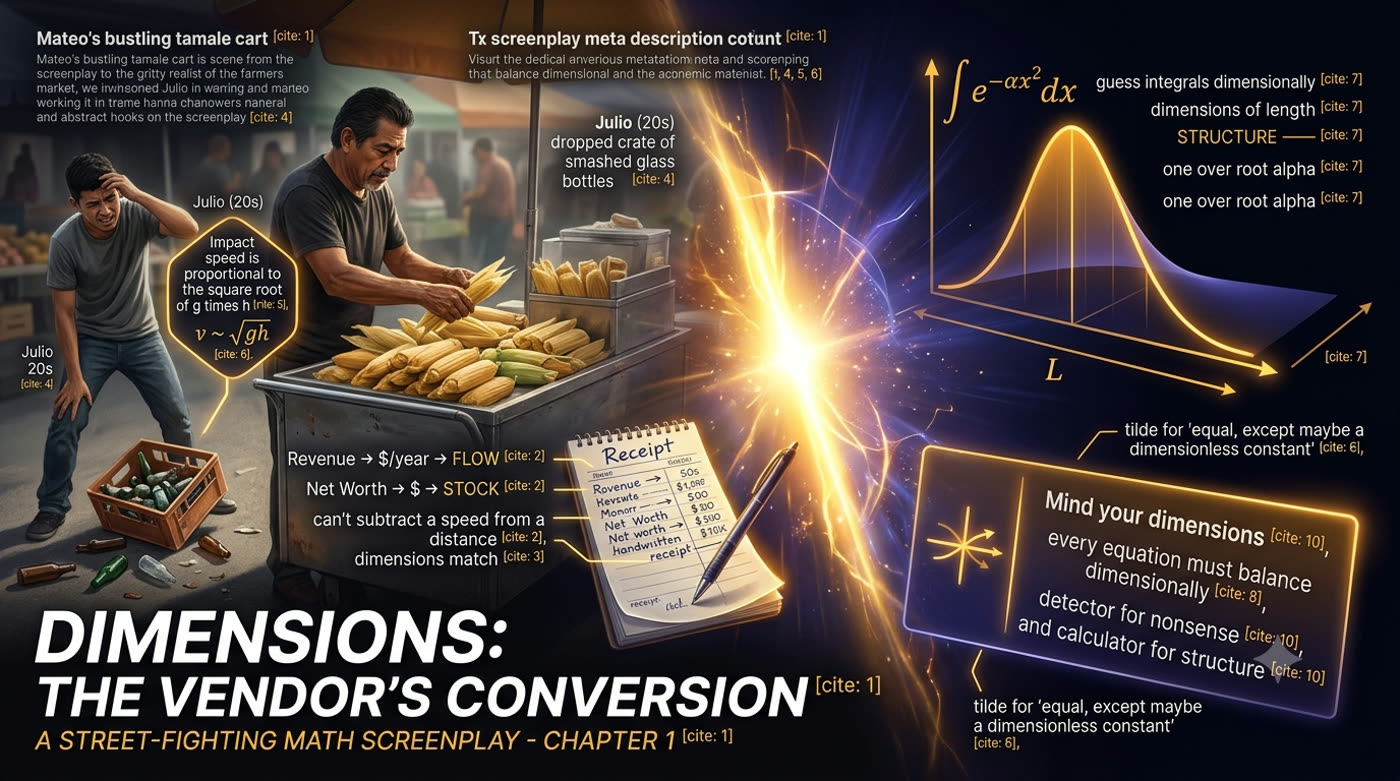
Those are numbers. They're not the same kind of number. Revenue is a FLOW. Dollars per year. Money moving through a pipe. Net worth is a STOCK. Dollars sitting in a bucket.

He writes on the pad:

  Revenue → $/year → FLOW
  Net Worth → $ → STOCK

MATEO (CONT'D)
You can't subtract a speed from a distance. You can't compare a flow to a stock. The units don't match.

CITY INSPECTOR
But they're both in dollars...

MATEO
A salary is in dollars per year. A savings account is in dollars. You wouldn't say "I earn less than I have saved, therefore I'm failing." That comparison changes depending on whether you measure your salary per year, per decade, or per week.
— 3 of 10 —
PAGE 3 — STOCK VS. FLOW
MATEO
Watch this. Suppose economists measured GDP per decade instead of per year. Nigeria's GDP goes from ninety-nine billion to nine hundred ninety billion — and suddenly it towers over Exxon's net worth. Now measure per week — Nigeria shrinks to two billion, and Exxon looks like a giant.

He scribbles the numbers:

  Per Year:   $99B vs $119B → Exxon "bigger"
  Per Decade: $990B vs $119B → Nigeria "bigger"
  Per Week:   $2B vs $119B → Exxon "huge"

MATEO (CONT'D)
Same reality. Three different conclusions. All because you're comparing a flow to a stock. The answer depends on an arbitrary choice of time unit — which means it's meaningless.

COUNCILWOMAN GRANT
(staring at the pad)
So what's the valid comparison?

MATEO
Compare like with like. My annual revenue versus MegaMart's annual revenue. Or my net worth versus their net worth. Either way, the dimensions match.

CITY INSPECTOR
Dimensions?

MATEO
The TYPE of thing you're measuring. Length, time, money, money-per-time. Every quantity has a dimension. Every equation has to balance dimensionally — or it's nonsense. That's the first rule of street-fighting math.
— 4 of 10 —
PAGE 4 — THE DROPPED CRATE
A CRASH from the loading area. Mateo's assistant, JULIO (20s), has dropped a crate of glass bottles from the truck bed — about five feet up.

JULIO
(wincing)
Sorry, boss. Think anything survived?

MATEO
(to the Councilwoman)
Perfect timing. Let me show you what dimensions can actually DO. Not just catch bad arguments — but predict answers without solving equations.

He walks to the loading area.

MATEO (CONT'D)
That crate fell from height h. Hit the ground at speed v. Gravity is pulling it at acceleration g. What's the impact speed?

CITY INSPECTOR
You'd need calculus for that. Differential equations.

MATEO
Or I could just look at the units.

He writes on the side of the truck with a marker:

  h → length → L
  g → length per time squared → L/T²
  v → length per time → L/T

MATEO (CONT'D)
I need to combine h and g to get something with units of speed — L/T. What combination works?
— 5 of 10 —
PAGE 5 — FINDING THE SPEED
MATEO
g has T-squared in the denominator. The only way to get T-to-the-minus-one for speed is to take the square root of g. That gives us square root of L over T squared — which is root-L over T.

He writes:

  √g → √(L/T²) → √L / T

MATEO (CONT'D)
But that's root-L over T. I need L over T. The square root of g only gives me half a length dimension — L-to-the-one-half. So I need another half-power of length. Where do I get it?

JULIO
(catching on)
From h. Square root of h is root-L.

MATEO
(grinning)
Exactly.

  √(g × h) → √(L/T² × L) → √(L²/T²) → L/T ✓

MATEO (CONT'D)
Impact speed is proportional to the square root of g times h. That's it. No calculus. No differential equations. Just matching dimensions.

COUNCILWOMAN GRANT
But is it exact?

MATEO
It's missing a dimensionless constant — a pure number with no units. The exact answer is root-two-g-h. My dimensions gave me root-g-h. Off by a factor of root-two — about forty percent. For a street estimate? That's gold.

CITY INSPECTOR
So you knew the speed without solving the physics?

MATEO
I knew the STRUCTURE without solving the physics. The square root, the dependence on height and gravity — all from units alone.
— 6 of 10 —
PAGE 6 — THE TILDE
MATEO
In street-fighting math, we have a symbol for "equal, except maybe a dimensionless constant." It's the tilde.

He writes: v ~ √(gh)

MATEO (CONT'D)
That squiggle means: I've got the right physics, the right dependence on every variable, maybe just missing a factor of two or pi or root-two. Stuff that doesn't change with the situation.

COUNCILWOMAN GRANT
Why is that useful? Isn't being off by a factor of two... bad?

MATEO
Think about it. The height might vary from a few inches — a bottle falling off a table — to thirty feet, a crate off a loading dock. That's a factor of a hundred in height. Which means a factor of ten in speed. THAT variation matters.

He gestures at the smashed crate.

MATEO (CONT'D)
The dimensionless constant root-two? It's 1.4. It never changes. The height changes. The gravity changes — on the moon, on Mars. The symbolic factors carry all the real information. The constant is just garnish.

JULIO
So the tilde is like saying "I've got the recipe right, just maybe a pinch more salt."

MATEO
(pointing at Julio)
Exactly. William James said the art of being wise is the art of knowing what to overlook. The tilde is that art in notation.
— 7 of 10 —
PAGE 7 — GUESSING AN INTEGRAL
Mateo leads them back to his cart, pulls out a battered notebook.

MATEO
Here's the real magic. You can guess integrals — entire calculus problems — without integrating. Just by checking units.

CITY INSPECTOR
That sounds impossible.

MATEO
Take the bell curve integral — e to the minus alpha x squared, integrated from negative infinity to infinity. What are the dimensions?

He writes: ∫ e^(-αx²) dx

MATEO (CONT'D)
Say x is a length — call it L. Then alpha must have units of one over L-squared, so that alpha-x-squared is dimensionless — because you can't exponentiate something with units.

  x → L
  α → 1/L²
  αx² → dimensionless ✓

MATEO (CONT'D)
The exponential is dimensionless. The dx has dimensions of L — "a little bit of x" is still a length. So the whole integral has dimensions of length.

  [∫ e^(-αx²) dx] = 1 × L = L

MATEO (CONT'D)
Now: what function of alpha gives me a length? Alpha is one-over-L-squared. So alpha-to-the-minus-one-half is...

JULIO
L. A length.

MATEO
The integral equals something times one over root-alpha. The "something" is a dimensionless constant — turns out it's root-pi. But the STRUCTURE — one over root alpha — we got for free.
— 8 of 10 —
PAGE 8 — DIMENSIONS OF EVERYTHING
MATEO
The rule is simple. Every equation must balance dimensionally. Every term in a sum must have the same dimensions. If they don't — the equation is wrong. No exceptions.

He ticks off on his fingers:

MATEO (CONT'D)
Energy: mass times length-squared over time-squared.
Power: energy per time.
Force: mass times length over time-squared.
Torque: force times length — same dimensions as energy, different meaning.

COUNCILWOMAN GRANT
This feels like basic physics.

MATEO
It IS basic. That's why it's powerful. Complex problems, simple tool. You don't need to understand the physics to check whether an answer is even POSSIBLE.

He writes on the pad:

  "I drive 60 miles per hour, which is much less
   than the Empire State Building at 1,454 feet."

MATEO (CONT'D)
Speed versus height. Miles-per-hour versus feet. That comparison is just as broken as the Councilwoman's revenue-versus-net-worth. Different dimensions, meaningless comparison.

CITY INSPECTOR
(slowly nodding)
So whenever someone compares two numbers and the units don't match...

MATEO
...they're either confused or trying to confuse you. Either way, the argument is dead on arrival.
— 9 of 10 —
PAGE 9 — THE INSPECTOR RETURNS
The Councilwoman is quiet. The Inspector is scribbling notes. Mateo hands them both tamales.

CITY INSPECTOR
Okay. So the valid comparison would be... your annual revenue versus MegaMart's annual revenue?

MATEO
Now you're comparing flow to flow. Dollars per year to dollars per year. Dimensions match.

COUNCILWOMAN GRANT
And if we compared net worth to net worth?

MATEO
Stock to stock. Also valid. Might be harder to get my number — I don't file quarterly reports — but at least the comparison would MEAN something.

CITY INSPECTOR
You know what's funny? MegaMart's annual revenue is about six hundred million. Compared to your twelve thousand — that's a fifty-thousand-to-one ratio. Even WORSE than the original comparison.

MATEO
(biting into a tamale)
Right. The valid comparison is actually more dramatic than the invalid one. That's the irony — you don't NEED to cheat the math. Reality is already stark enough. When people mix dimensions, it usually means they're lazy, not clever.

COUNCILWOMAN GRANT
(half-smiling)
Or that they read it in a report without checking.

MATEO
Same thing.
— 10 of 10 —
PAGE 10 — THE LESSON
The market is filling up. Customers lining up at Mateo's cart. He wipes his hands.

MATEO
(to both of them)
Here's what dimensional analysis gives you. Three things.

He holds up three fingers.

MATEO (CONT'D)
One: a detector for nonsense. If the dimensions don't match, the argument is broken. Period. Doesn't matter how many PhDs signed off on it.

Two: a calculator for structure. Even when you can't solve the equation, dimensions tell you HOW the answer depends on the inputs. Square root of height times gravity — that's not a guess. That's a constraint.

Three: a speedometer for integrals. You can determine the functional form of integrals without ever integrating. Just from the requirement that both sides of the equation have the same dimensions.

CITY INSPECTOR
(closing his notebook)
I think we need to re-do that vendor assessment report.

COUNCILWOMAN GRANT
(standing up, brushing off crumbs)
I think we need to re-do a lot of reports.

MATEO
(calling after them)
Remember — you can't add apples to oranges. And you can't compare a flow to a stock. Mind your dimensions.

FADE OUT.